

In Part I, we discussed a common Emergency Department/Urgent Care scenario: a patient with a crush injury to the finger with an open tuft fracture. We addressed the anatomy, the issue of local washout vs. operative management, & appropriate splinting.
Here in Part II, we will address the lingering questions of prophylactic antibiotics, follow up, and the decisions made in this particular case. I’ll even close with a short summary video!
What is the role of prophylactic antibiotics in open tuft fractures?
Orthopedics providers where I work will sometimes advise me to “follow the protocol” of giving a patient with an open tuft fracture a gram of intravenous cefazolin, wash the wound out well, and then send them home on cephalexin. As I sometimes practice in an Urgent Care setting–where placement of an IV and access to intravenous antibiotics isn’t feasible–I began to wonder how strongly rooted in medical evidence this practice really is.

The Bottom Line
I couldn’t really find any evidence-based protocols in the literature to support the practice of IV antibiotic administration, or for that matter, routine use of prophylactic antibiotics at all, specific to open tuft fractures.
- To the contrary, this 2016 systematic review and meta-analysis by Metcalfe, et al. suggests that there is no effect of prophylactic antibiotics on the rate of superficial infections for open distal phalanx fractures.
- A similar conclusion was drawn in this 2023 retrospective review by Schaefer, et al. of fingertip crush injuries, which was admittedly underpowered.
However, let me take a step back and play devil’s advocate here. In my laceration repair work I’ve researched if prophylactic antibiotics are supported by the literature across a spectrum of conditions: ear and nasal lacerations involving cartilage, various bite wounds, & otherwise uncomplicated lacerations in patients with immunocompromise. The reality is that it is rare that evidence ever supports the practice of prophylactic antibiotics in these situations. Much of the reason for this is that the types of studies that would need to be run to be properly powered to determine a true difference in infection rates +/- antibiotics are exceptionally difficult to design and implement. So it’s often the case that we have to make the best clinical decision we can based on extrapolating evidence from related situations, and considering the risk benefit ratio to the patient.
With that said, here is the counter argument in favor of prophylactic antibiotics:
- Prophylactic antibiotics are well studied and evidence-supported for use in open fractures in general, and early administration is associated with better outcomes. They are part of established guidelines used by Orthopedic Surgeons.
- Prophylactic antibiotics are best studied for long bone fractures, such as tibia fractures. That’s the rationale between the use of an IV dose, to achieve a therapeutic window in the bloodstream asap.
- Barring patient allergy or previous adverse reaction, since the recommended antibiotics are first generation cephalosporins such as IV cefazolin or PO cephalexin, the argument could be made that there is little downside to administration of these generally well-tolerated antibiotics in a situation which is potentially high-stakes for the patient.
Should you give prophylactic antibiotics for open tuft fractures? It’s a risk-benefit analysis with poor evidence to directly guide you. I’d recommend deferring to local protocols (or meeting with stakeholders in your practice setting to get on the same page), as well as a practice of informed shared-decision making with your patient.
Follow up
Perhaps the most important point here is that all of these patients require some sort of follow up, to assess appropriate healing and to determine if infection has occurred. In cases of non-union, a qualified provider may consider surgical fixation.
Key points:
- Get these patients to a qualifed orthopedic provider within a week.
- Depending on your local system, this may be a hand surgeon, a general orthopedic surgeon, a physician assistant, or a nurse practitioner.
- In the meantime, have them keep the splint in place, with instructions to seek earlier care for signs of infection (increasing pain, purulent drainage, redness of the finger, fevers, etc).
Case conclusion
Here’s how I managed the case (yes, this is where the rubber meets the road!)
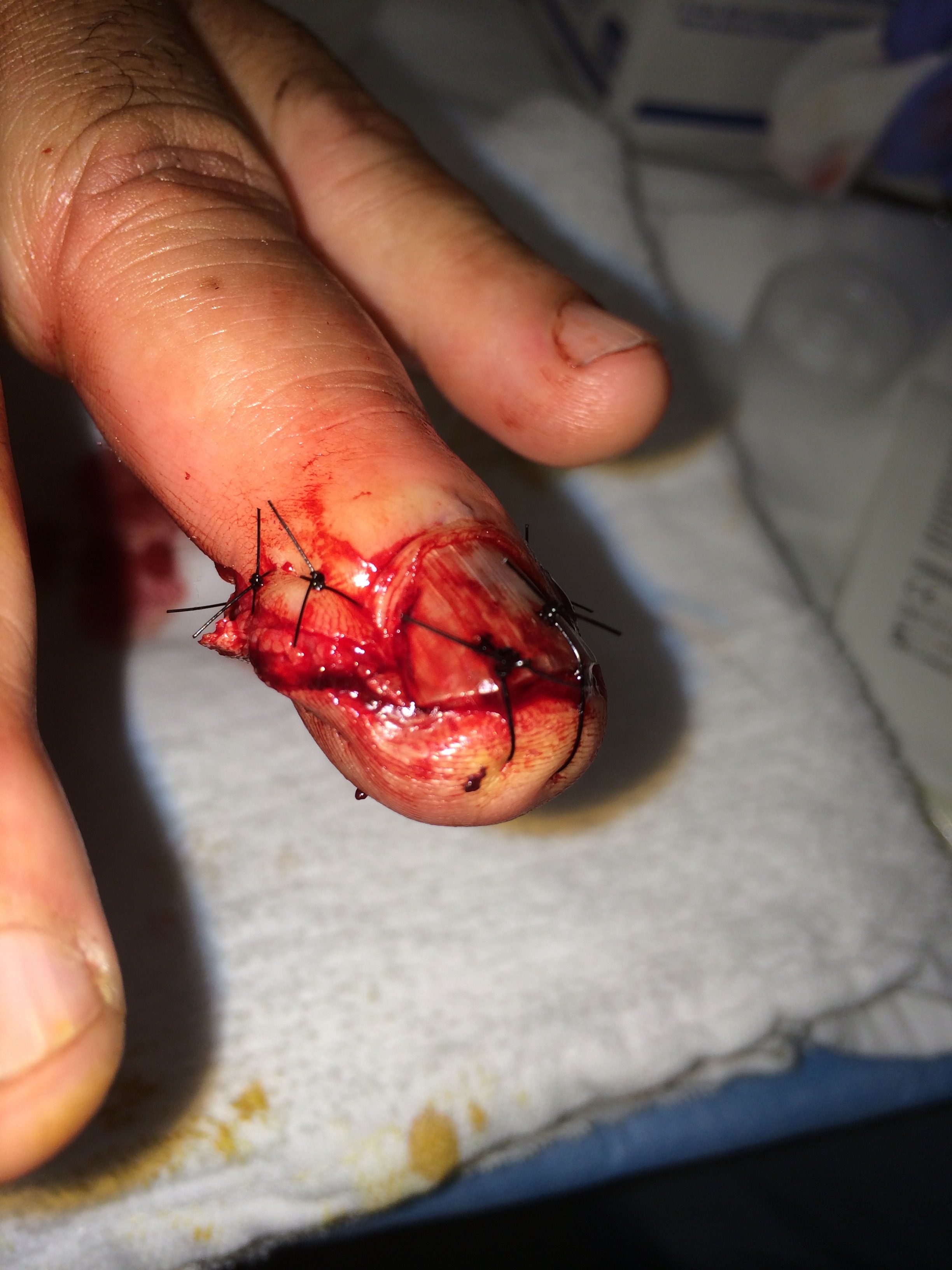
- Firstly, a digital block to ensure everything that followed would be painless!
- Then, a local washout in the ED with 500 cc of sterile normal saline. (Evidence supports tap water use for uncomplicated lacerations; this injury would be excluded!)
- Primary closure with 5 x 4-0 nylon simple interrupted sutures, without removal of the native nail which remained firmly implanted in the eponychial fold.
- I splinted using an aluminum U-shaped splint, leaving the PIP joints and MCP joints free to prevent stiffness.
- I did give a course of prophylactic antibiotics. I didn’t place an IV just to give a first dose of cefazolin. I compromised with the orthopedic surgeon and gave the first dose of cephalexin soon after arrival.
Still wanting more? Here’s a 3-minute video summarizing the key points of this case. Follow up pictures of the healed wound are included!!
 Closing the Gap